Selective vs. Non-Selective Herbicides: How to Match Them to Crops and Application Scenarios?
Selective vs. Non-Selective Herbicides: How to Match Them to Crops and Application Scenarios?
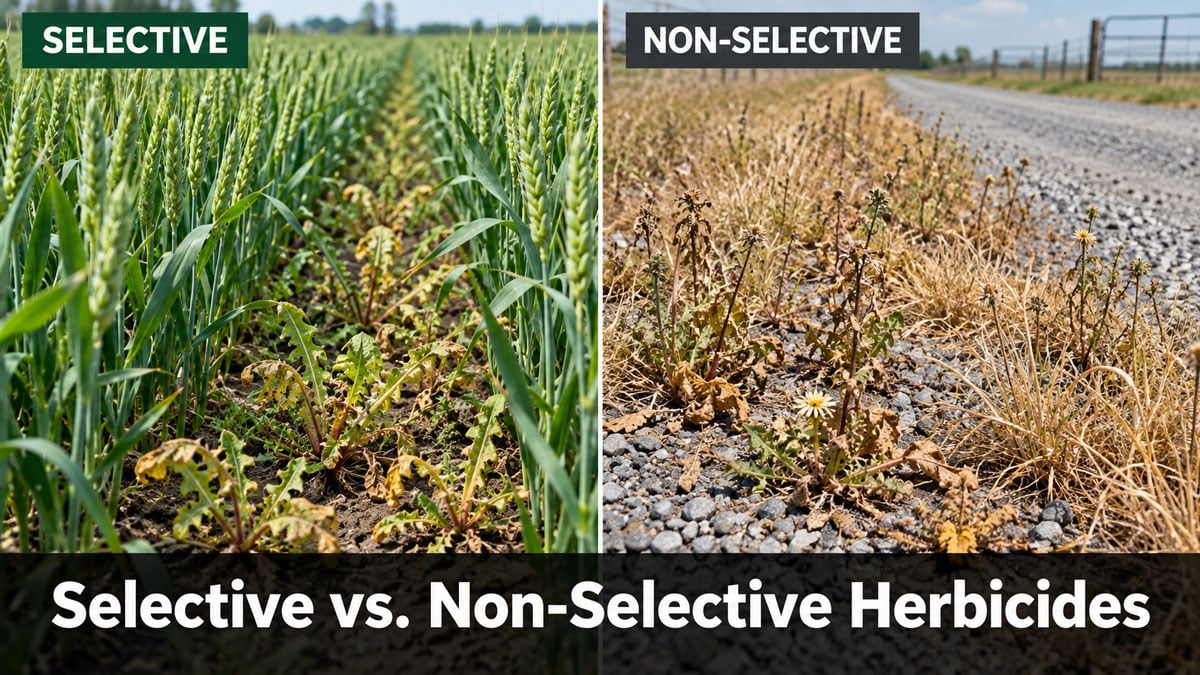
When choosing between selective and non-selective herbicides, first identify the crops to be preserved, the weeds to be controlled, as well as the application timing and spray location. If the crop has already emerged and you plan to apply a blanket spray in the field, you should prioritize verifying the product’s suitability for that crop; for pre-planting weed control, orchard row-between applications, or approved non-crop area management, non-selective products may also be appropriate. The final choice must be based on the specific product’s local registration and label conditions.
For importers, distributors, and brand owners, these two types of products may play different roles in the market. Customers need to know not only what weeds the product controls but also under what conditions it can be used. Only by clearly communicating this information can the active ingredients, formulation, packaging, and purchase quantities be further determined.
What are the key differences between selective and non-selective herbicides?
Selective herbicides control certain weeds under specified conditions while maintaining acceptable tolerance in the target crop. The term “selective” here is relative and requires clarification of both the target weeds and the crops to be protected.
Non-selective herbicides are active against a wide range of plants and may cause damage when applied to sensitive crops. Their agricultural use typically requires consideration of application timing, spray location, or specific crop tolerance conditions.
| Comparison Criteria | Selective Herbicides | Non-selective Herbicides |
|---|---|---|
| Key Considerations | Whether the herbicide can control target weeds while meeting the crop’s tolerance requirements | Whether the herbicide can control target weeds while avoiding exposure of non-target crops |
| Crop Use | Requires verification of specific crops, varieties, or types, as well as growth stages | Verify pre-plant, directed application, or other approved application methods |
| Weed Scope | May target grasses, broadleaf weeds, sedges, or a combination thereof | The spectrum of weed control is generally broad, but there are specific limitations and variations in efficacy |
| Application Site | Some products allow post-emergence whole-plant spraying on crops, while others have site restrictions | Certain applications require directed spraying, shielding, or application before crop emergence |
| Procurement Considerations | Check for compatibility between crops and weeds, and ensure the application window is suitable for local production | Are the application scenarios clearly defined, and do the equipment and usage conditions meet the requirements? |
“Selective” does not mean suitable for all crops, and “non-selective” does not mean it can control all weeds. Whether a product is suitable must be determined based on weed species, growth stages, local resistance, and usage conditions.
Why Do Selective Herbicides Also Have Application Conditions?
Customers often ask, “Since these are selective herbicides, why does the crop stage matter?”
This is because a crop’s tolerance to herbicides can stem from various factors. Some crops can metabolize the active ingredient relatively quickly; in other cases, application methods—such as the site of application—reduce contact between the crop and the herbicide. Morphological and physiological differences between crops and weeds may also affect how the herbicide works.
Syngenta’s technical documentation lists application site, plant morphology, physiology, and metabolic differences as key factors in selectivity, and notes that stressors such as drought, waterlogging, and frost may affect a crop’s tolerance to certain selective herbicides.
Therefore, even if a product is indicated for a particular crop, the following must still be verified:
- whether the label includes that crop, as well as the applicable varieties or crop types;
- Whether the crop growth stage and weed stage fall within the specified application window;
- Whether the application rate, number of applications, adjuvants, and mixing conditions meet the requirements;
- Whether soil, weather, and crop conditions comply with the relevant restrictions.
Safety conclusions for the same active ingredient cannot be directly applied to different crops or under different usage conditions.
For distributors, it is best to present the crop, weeds, and application window together in sales materials. If customers only remember the term “selective” but fail to recall the applicable conditions, subsequent communication is prone to misunderstandings.
First confirm the crop, then identify the specific weeds
“I need a herbicide” is not sufficient for accurate product selection. Even if the customer has specified the crop, it is still necessary to confirm the primary weeds in the field.
| Weed Categories | Information to Confirm | Why It Affects Product Selection |
|---|---|---|
| Grass Weeds | Specific species, annual or perennial, leaf stage, and whether tillering has occurred | Just because a product controls one type of grass weed does not mean it controls all other grass weeds |
| Broadleaf weeds | Specific species, population density, size, and growth stage | Different broadleaf weeds may have varying sensitivities to the same active ingredient |
| Cyperaceae weeds | Specific species, growth stage, and reproductive characteristics | Do not automatically apply grass weed products simply because the weeds resemble grasses |
| Mixed weed communities | Which species are the primary targets, and do they emerge in batches? | It is necessary to assess the coverage of a single product and the role of other management measures |
The crop itself must also be clearly identified. Rice, wheat, and corn are all grass crops, but their respective herbicide applications cannot be inferred from one another.
“Effective against grass weeds” and “suitable for use on grass crops” are two distinct issues that must be verified separately.
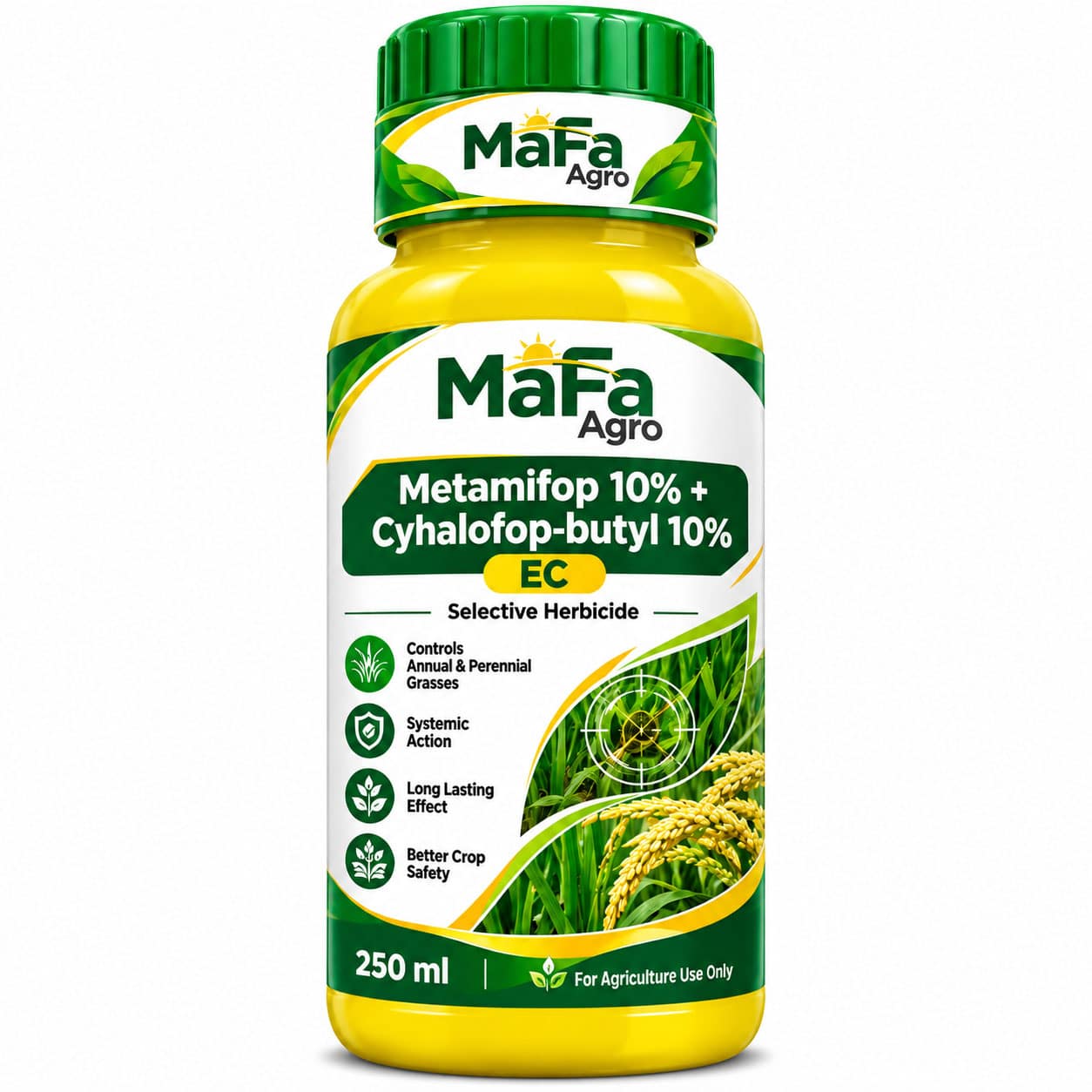
Taking Clethodim as an example, Nufarm Spain’s KLETOFARM product is positioned for post-emergence control of grass weeds in broadleaf crops. Corteva’s Cyhalofop-butyl product, Clincher CA, is approved for post-emergence control of grass weeds in rice, including targets such as barnyard grass.
These two examples illustrate that even when the mode of action is similar, crop applications may still differ. Overseas product examples can aid in understanding classifications but cannot be directly used as authorization for the use of other products in the target country.
When a client requests a solution for barnyard grass in rice fields, one should verify the specific products suitable for that rice production system; the intended use cannot be determined solely based on a particular active ingredient’s activity against barnyard grass.
How can different application scenarios help narrow down product selection?
When selecting products, it is more helpful to clearly specify both “where it will be used” and “when it will be used” than to simply ask which class of active ingredients is more potent.
The table below is used to organize evaluation criteria; specific active ingredients and products still require item-by-item verification of local uses.
| Application Scenarios | Priority Evaluation Areas | Conditions Requiring Further Confirmation |
|---|---|---|
| Pre-planting control of weeds that have already emerged | Products with appropriate pre-planting applications and a suitable spectrum of weed control; may include non-selective products | Weed species and size, subsequent crops, sowing interval, and other ingredients in the formulation |
| Crop has emerged; planning for broadcast application | Products with post-emergence use on this crop and corresponding tolerance conditions | Crop type, growth stage, weed stage, application rate, and related restrictions |
| Weed control between rows in orchards or plantations | Products with appropriate registrations for directed or shielded application; may include non-selective products | Crop type, tree age, sensitive parts, equipment, and label requirements |
| Control of weeds emerging in subsequent growth | Products with appropriate soil residual uses | Suitable crops, soil conditions, moisture levels, application location, and requirements for subsequent crops |
| After harvest, before planting the next crop | Products compatible with target weeds and subsequent planting plans | Regrowth of weeds, rotation crops, planting intervals, and residual effects |
| Approved non-crop areas | Products approved for use at that location | Surrounding vegetation, water bodies, area restrictions, and subsequent land use |
If the customer’s request is for “post-emergence control of grassy weeds in soybeans,” the assessment should focus on soybean suitability and the specific grassy weeds.
If the customer requires “pre-planting control of existing mixed weeds in the field,” the assessment should focus on pre-planting applications, weed coverage, and subsequent planting plans.
Both needs may arise in the same area, but they do not necessarily require the same product. The clearer the application scenario, the easier it is to narrow down the procurement scope.
How does selectivity relate to pre-emergence and post-emergence?
These classifications address different questions.
Selective versus non-selective primarily describes differences in tolerance among plants. Pre-emergence and post-emergence describe the timing of application; contact and systemic describe the mode of action of the herbicide within the plant; and soil residual efficacy relates to the management of subsequent weed emergence.
| Classification Dimensions | Issues Customers Need to Understand |
|---|---|
| Selective/Non-selective | Which plants need to be controlled, and which need to be preserved |
| Pre-emergence/Post-emergence | At what stage relative to crop or weed emergence is the product applied |
| Contact/Systemic | How the herbicide acts on treated plants |
| Soil residual activity | Does the product have the appropriate application to control weeds that emerge later? |
When discussing “pre-emergence,” it is important to clarify whether this refers to before crop emergence or before weed emergence.
For example, removing weeds that have already emerged before crop seeding constitutes a post-emergence treatment for those specific weeds. This use does not directly prove that the product can control weeds that will emerge from the soil in the future.
Similarly, the fact that a product induces foliar symptoms relatively quickly does not, by itself, confirm its ability to provide complete control of perennial weeds.
For procurement projects, we recommend listing the application timing, mode of action, and whether soil residual activity is required separately in the specifications to avoid combining different objectives into a single phrase such as “effective and long-lasting.”
How to Match Non-Selective Herbicides to Orchards and Plantations?
The presence of weeds between rows in an orchard does not imply that fruit trees are naturally tolerant to herbicides applied in those rows.
For applications requiring directed or shielded spraying, crop protection depends on correct application methods. It is necessary to check the specific label to determine whether the spray solution may come into contact with leaves, green stems, tender bark, suckers, or other sensitive areas.
Penn State resources caution that accidental application of glyphosate to areas such as the thin bark of young trees may cause damage. Therefore, when introducing applications for orchards, the crop, application site, and protection requirements should all be clearly explained.
Distributors should focus on verifying three key aspects:
First, product uses. Does the product list local target fruit trees or plantation crops, along with the corresponding application methods?
Second, crop condition. Do the tree age, growth stage, and sensitive areas meet the label requirements?
Third, equipment capability. Can end-users control the spray application location and implement the label’s requirements for directional spraying, shielding, and drift prevention?
When these conditions cannot be confirmed, simply citing “non-selective” and “broad-spectrum weed control” is insufficient to recommend a product.
Why is it also necessary to verify the follow-up crop and resistance status?
When selecting a herbicide, one must consider not only the current crop but also the land’s intended future use.
The University of Minnesota’s agricultural guidelines note that many herbicide labels specify planting intervals for subsequent crops. Rotation, replanting, or other planting restrictions listed on local labels should be directly incorporated into the plan verification process.
Before purchasing, you can confirm the following with the customer:
- What crop is planned for the next rotation;
- When planting is expected;
- Whether there are plans for replanting or crop substitution;
- Whether the current plan includes ingredients with soil residual activity.
This information cannot be inferred from labels such as “selective” or “non-selective.”
Resistance management also requires separate evaluation. The “selective” classification cannot replace the HRAC mode-of-action classification. Switching from one selective product to another non-selective product is not sufficient to demonstrate rotation among different modes of action.
The HRAC notes that long-term, repeated use of herbicides targeting the same site of action increases the selection pressure for resistance. When evaluating a program, verify each ingredient’s group classification, efficacy against the target weeds, local resistance information, and approved uses, and consider applicable agricultural and mechanical management practices.
If a product’s efficacy declines, first investigate the weed identity, growth stage, application conditions, and application history; do not automatically assume that simply switching to a different classification will solve the problem.
How can distributors compare specifications, costs, and product line value?
Classifications help you determine the direction, but procurement must still be based on complete commercial specifications.
First, the items being compared should have clearly defined market roles. For example, pre-planting weed control products and post-emergence selective herbicides for crops may serve different purposes; simply ranking them by price per liter makes it difficult to determine which offers better value.
For the same crop, target weeds, and control objectives, you can first calculate:
Product cost per hectare per application = CIF unit price (per liter or per kilogram) × product application rate per hectare as permitted by the local label.
Next, verify the adjuvants required by the label, necessary combinations, actual application schedules, and other costs. When calculating inputs for the entire growing season, a comprehensive plan must be used.
| Procurement Comparison Items | Items to Verify |
|---|---|
| Market Role | Specific Needs (e.g., pre-plant control, post-emergence crop control, inter-row management, or soil residual efficacy) |
| Product Identification | Active ingredients, concentration, units of measurement, formulation, and complete formulation specifications |
| Crop suitability | Crops, varieties or types, growth stages, application methods, and restrictions |
| Weed coverage | Specific weeds, growth stages, local efficacy, and resistance status |
| Cost-Effectiveness | Product cost per hectare, required combinations, and seasonal program costs |
| Quality Acceptance | Applicable test items, methods, acceptance limits, and batch results |
| Packaging and Labeling | Channel specifications, language, brand identity, sealing, and packaging compatibility |
| Documentation and Registration | COA, SDS/MSDS, TDS, and other documentation required for the relevant items |
For products containing safeners, the relevant ingredients and complete specifications must be clearly defined. Two products cannot be deemed to have identical crop tolerance profiles solely based on the fact that they share the same active herbicide ingredient and concentration.
Formulations should also be verified separately. Performance criteria vary for formulations such as SL, EC, SC, OD, and WG; sample evaluation and batch acceptance should use pre-agreed methods and standards.
COAs support batch specification verification; efficacy data support the evaluation of control performance; and registration documents support the verification of approved uses. These documents serve different purposes and cannot be used interchangeably.
When configuring a product line, there is no need to set a fixed stock ratio for selective versus non-selective products. More practical considerations include: what specific need does this product address, whether existing products already cover that need, and whether anticipated orders can support a reasonable inventory level.
Frequently Asked Questions
Are selective herbicides guaranteed not to harm crops?
No such guarantee can be made. Specific product requirements regarding crop type, growth stage, application rate, application method, and other label conditions must be followed; the condition of the crop may also affect tolerance.
Can non-selective herbicides only be used on roads or wasteland?
No. Some products are approved for pre-sowing application, targeted spraying in orchards, or other agricultural uses; these must be confirmed based on specific registrations and labels, and their uses cannot be directly expanded.
Can any product that controls barnyard grass be used in rice fields?
This cannot be determined in this way. It is also necessary to verify the product’s suitability for rice, the production system, the application stage, and the approved uses. Weed activity and crop tolerance are two distinct issues.
Are all selective herbicides post-emergence products?
No. “Selective” and “pre-emergence/post-emergence” are different classification categories; the crop, weeds, and application timing must be verified separately.
After pre-planting weed control, when can seeding begin?
This depends on the specific product label and the subsequent crop. You need to verify the planting interval, the complete formulation, and whether there are any other relevant restrictions; there is no standard waiting period.
Do all non-selective herbicides lack soil residual activity?
You cannot make a direct judgment based on this classification alone. You should review the specific active ingredients, formulation, and product information, and verify both the residual weed control and the conditions for the subsequent crop separately.
Does switching from a selective to a non-selective herbicide complete resistance rotation?
Not necessarily. You need to verify the HRAC group, efficacy against target weeds, and local program requirements; the classification name alone is insufficient to prove that the mode of action is different.
How should importers describe their herbicide needs to suppliers?
Provide the destination country, target crop, specific weeds, application timing, and method, followed by details on the required active ingredients, concentrations, formulation, purchase volume, packaging, and documentation requirements. The more specific the information, the easier it is to accurately compare supply proposals.
Identify the right herbicide specifications for your market
If you are screening herbicides for import, distribution, or private-label projects, you can provide the following information to Mafa Agro:
- Destination country, company type, and local registration status;
- Target crops and other vegetation that needs to be preserved;
- Major weed species, size, and local application feedback;
- Planned application timing, spray location, and equipment conditions;
- Follow-up cropping or rotation plans;
- Required active ingredients, concentrations, formulations, and estimated purchase volume;
- Packaging specifications, label language, brand, and technical documentation requirements.
Based on the specific product and project conditions, we will verify available specifications, documentation, and packaging options to help you narrow down your selection and clarify the details that need to be confirmed for sample evaluation and subsequent procurement.
 Abamectin vs. Emamectin Benzoate: How to Match Different Pest Control Needs?
 SC, EC, and WG: What Should Importers Consider When Selecting Pesticide Formulations?
Tell Us What You Need
Looking for pesticide products from China? Send us the active ingredient, formulation, quantity, packaging requirement or target crop. Our team will help you evaluate suitable supply options.