Abamectin vs. Emamectin Benzoate: How to Match Different Pest Control Needs?
Abamectin vs. Emamectin Benzoate: How to Match Different Pest Control Needs?
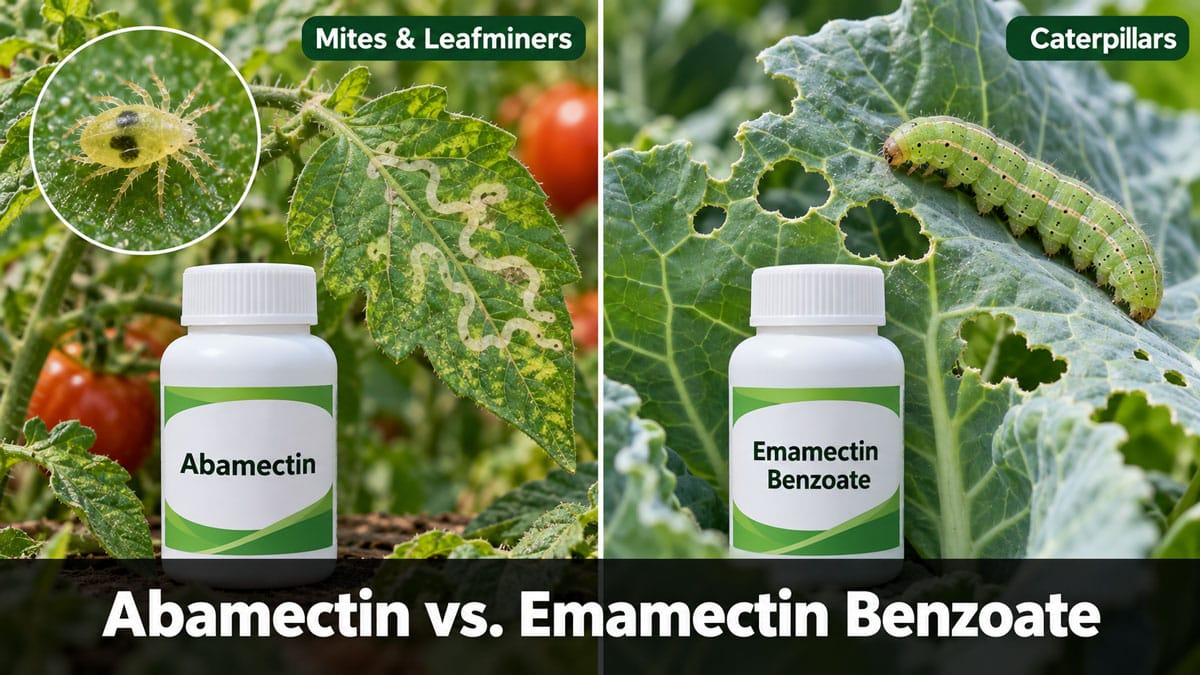
When choosing between Abamectin and Emamectin Benzoate, first consider the target pest species. For leaf mites and certain leafminers, prioritize evaluating Abamectin products with the appropriate registration;
For control of Lepidoptera larvae such as the diamondback moth and cutworms, prioritize evaluating Emamectin Benzoate products with the appropriate registration. While there is some overlap in the target pests for both, the final decision should be based on the target crop, local efficacy data, and product labels.
Both belong to IRAC Group 6; substituting one for the other does not constitute a rotation to a different mode of action.
For importers, distributors, and brand owners, this choice will also impact product positioning, inventory, packaging, and channel training. Customers need to understand which problems a product is suitable for solving, what conditions must be met for its use, and what they should verify before purchasing. The comparison below focuses on foliar application in agriculture to help you align ingredient selection with market demand.
What are the key differences between Abamectin and Emamectin Benzoate?
The primary commercial positioning of the two active ingredients differs. Abamectin is frequently found in products for controlling leaf mites and certain leaf-mining insects; Emamectin Benzoate is commonly positioned for the control of Lepidoptera larvae. These positioning distinctions can help you narrow down your product selection, though specific applications must still be verified for each individual product.
| Comparison Criteria | Abamectin | Emamectin Benzoate |
|---|---|---|
| Common Application Areas | Control of leaf mites and certain leafminers | Control of Lepidopteran larvae |
| Cross-applications | Some product labels mention Lepidopteran pests | Some product labels mention control of leafminers or leaf mites |
| IRAC Group | Group 6 | Group 6 |
| Characteristics of Foliar Uptake | May exhibit foliar penetration and localized activity | Foliar products may also exhibit characteristics of foliar uptake |
| Key Points for Specification Comparison | Active ingredient concentration, formulation, labeled uses, and actual application costs | Active ingredient concentration, formulation, labeled uses, and actual cost of use |
| Product Line Assessment | Does it meet local needs for reliable miticide or related insecticide control? | Does it meet local needs for specific control of Lepidoptera larvae? |
According to the IRAC 2026 classification of modes of action, both belong to the class of glutamate-gated chloride channel allosteric modulators, namely GluCl allosteric modulators. Although they share the same mode of action, this does not mean they have the same efficacy, recommended dosage, or commercial value against every pest.When procuring products, it is necessary to verify “common uses of the active ingredient” separately from “the approved uses of a specific product.”
For which pest control needs should Abamectin be prioritized for evaluation?
If your primary clients consistently face leaf mite problems on crops such as fruit trees and vegetables, you may include Abamectin products with appropriate registrations and local efficacy data in your evaluation.
During the evaluation, in addition to confirming the crop and mite species, it is important to understand the field population stage. The ratio of eggs to active mites, the severity of the infestation, and previously used pesticides will all influence the subsequent treatment plan. Even if a product is suitable for a particular type of mite infestation, it must be applied under the appropriate conditions.
Abamectin also has approved uses for controlling certain leafminers. You’ll need to further confirm the pest species, crop, and scope of registration—particularly distinguishing between leafminer flies and different species of leafminer moths.
Distributors can start by gathering the following information:
- Which crops are primarily affected, and what are the specific pest species;
- Current pest population levels, predominant life stages, and any new damage patterns;
- Whether corresponding products are already registered locally;
- Which active ingredients have been used recently, and has their efficacy changed?
- What packaging do downstream customers require, and what is the projected demand?
If a market already has stable demand for Abamectin, procurement priorities can shift to batch quality, appropriate packaging specifications, channel pricing, and restocking arrangements. Increasing the concentration or changing the packaging should be based on clear market justification.
For which pest control needs should Emamectin Benzoate be prioritized for evaluation?
When the primary need is to control Lepidoptera larvae such as the diamondback moth and cutworm, Emamectin Benzoate products with corresponding registrations should be prioritized for evaluation.For such needs, attention must be paid to the larval stage and whether the larvae have already entered concealed areas. Products targeting larval control typically need to be used in accordance with label requirements, during the appropriate life stage and within the application window. Once large numbers of larvae have spun webs or burrowed into fruits or stems, conditions for pesticide contact and ingestion exposure may have changed.When selecting products, consider the following three questions:
- Does the product label cover the target crop and specific pest species?
- Does local monitoring data support an appropriate application timing?
- Can existing spraying equipment achieve the coverage required by the label?
When assessing effectiveness, observe changes in live pests, feeding activity, and new damage simultaneously. Existing leaf damage or feeding tunnels will not immediately heal upon the pest’s death; judging efficacy based on old damage can lead to inaccuracies.
For distributors, clearly explaining the pest life stage, application window, and efficacy assessment methods helps customers form reasonable expectations and facilitates subsequent technical communication.
Since they are all leafminers, why is it necessary to first confirm the pest species?
“Leafminer” describes a class of damage symptoms; customers may use this term to refer to different pests. Even when leafmining trails are visible on leaves, further identification is still required.
| What the customer is describing | Differences that need to be identified | Key considerations when selecting a product |
|---|---|---|
| Liriomyza leafminers | Larvae of Diptera pests feed inside leaves | Verify the specific species, crop, and product label |
| Citrus leafminer | Lepidopteran pest; damage is associated with young shoots | Determine based on new shoot growth and registered uses |
| Tuta absoluta | Tomato leafminer, with its own specific occurrence patterns and resistance characteristics | Verify local efficacy, application history, and recommended treatment plans |
Label terminology must also be read carefully. “Control” refers to pest control, while “Suppression” refers to suppression; the scope of each term differs. For example, the U.S. registration label for Proclaim lists Liriomyza leafminers or leaf mites as Suppression Only for certain crop uses. This example illustrates that the label positioning for the same active ingredient can vary across different crops and targets.Therefore, when customers inquire about products for leafminers, first confirm the pest species, then verify the crop and label. For pests whose identity has not yet been confirmed, first collect clear photographs, information on the damaged areas, and occurrence details, then have local technical personnel confirm the identification.
Why Are Foliar Uptake, Application Timing, and Coverage Important?
Foliar permeability, also known as translaminar, is a key concept for understanding this type of foliar product. Once the active ingredient enters the treated leaf tissue, it can alter the conditions under which pests come into contact with or feed on the pesticide.
This characteristic must still be combined with appropriate spray coverage techniques. When pests are located on the underside of leaves, within the leaf tissue, or in other concealed locations, verify the product’s specific application requirements; similarly, newly emerging tissue cannot be assumed to be protected solely based on “leaf absorption.”
Product labels may specify requirements for water volume, application methods, and adjuvants. Procurement and distributor training should use the product’s specific instructions and verify suitability in conjunction with the target crop.
When comparing the rapid onset or residual efficacy of two products, use data from well-defined conditions whenever possible, and ensure you understand at least the following:
- Whether the crop and pest species are the same;
- The pest life stage and population pressure at the time of application;
- The product formulation, label rate, and coverage conditions;
- weather conditions, observation periods, and evaluation criteria.
Only comparisons made in this manner will aid in product selection. A single figure indicating “how many days of residual efficacy” or “how many hours until onset of action” is often insufficient to predict how a product will perform in your market.
For cropping systems that utilize natural enemies or other biological control measures, you should also verify the specific product’s impact on relevant natural enemies and its application requirements, and integrate chemical control into the local integrated pest management (IPM) program.
Both belong to IRAC Group 6—how should resistance management be planned?
Abamectin and Emamectin Benzoate have different product names but belong to the same IRAC group. When alternating between these two active ingredients against the same pest, this should not be marketed as a rotation based on different modes of action.
Belonging to the same group does not mean that resistance levels are exactly the same across all regions or pest species. When the efficacy of a product declines, it is necessary to first verify the pest species, life stage, application coverage, product quality, and application history, and determine the cause based on local resistance data.
When developing a management plan, key considerations include:
- Which products from different IRAC groups are approved locally and effective against the same target pest;
- How to schedule pest generations or application windows;
- The number of applications, intervals, and other label conditions for each product;
- Whether monitoring, agronomic practices, and biological control can reduce unnecessary applications.
For distributors, there may be clear commercial reasons to sell two Group 6 products simultaneously, such as to address the needs for mite control and lepidopteran larval control, respectively. Product lines can be complementary, but resistance management must still be assessed separately based on mode of action and target pests.
Group information in labels, promotional materials, and sales training should be consistent to facilitate understanding by downstream customers.
How to compare active ingredient concentrations, formulation types, and cost per hectare?
When comparing Abamectin 1.8% EC and Emamectin Benzoate 5% WG, the percentage concentration alone is insufficient to determine which is “stronger” in the field.Their active ingredients, formulations, target pests, and label application rates may differ. When purchasing, it is also necessary to confirm the units of concentration and measurement standards—for example, whether the percentage is w/w or w/v, and whether the labeled g/L value is consistent with the specifications being compared.
Formulation names must also be accurately verified.
| Formulation Types | Basic Definitions | Key Considerations During Procurement |
|---|---|---|
| EC | Emulsifiable Concentrate | Emulsification performance, storage stability, and crop suitability |
| SC | Suspension Concentrate | Suspension, redispersibility, pouring, and storage performance |
| WG/WDG | Water-dispersible granules | Wetting, dispersion, suspension, and granule storage performance |
| SG | Water-soluble granules | Dissolution, solution stability, and applicable items such as insolubles |
WG/WDG and SG must be described separately. Even if granules have a similar appearance and the same percentage of active ingredient, they cannot be directly classified as the same formulation.
When comparing quotes, first calculate:
Product cost per hectare per application = CIF unit price (per liter or per kilogram) × application rate per hectare permitted by the local label.
This comparison should be based on the same target crops and pest species, with corresponding supporting evidence for applicability. Then consider the adjuvants required by the label, the actual number of applications, packaging costs, and distribution channel service costs.
If comparing inputs for an entire growing season, calculations must also incorporate the actual pest control plan. The cost per hectare helps you assess the economic viability of a purchase, while the suitability of a product for your specific needs requires support from efficacy data and registration information.
What quality documentation should be verified before purchasing?
Once the active ingredients have been determined, clear acceptance criteria should be established for both samples and bulk products.
During procurement discussions, we recommend first clearly defining the active ingredients, concentration, formulation, applicable testing items, and packaging requirements before comparing supplier proposals. This ensures both parties are discussing the same commercial specifications, making it easier to align sample evaluation with batch acceptance.
| Items to Verify | Recommended Specifications |
|---|---|
| Ingredients and Specifications | Identity of active ingredients, units of content, dosage form, and agreed-upon ranges |
| Content Testing | Corresponding test methods, batch results, and acceptance criteria |
| Dosage Form Performance | Select items such as emulsification, suspension, dispersion, or dissolution based on the actual dosage form |
| Storage Stability | Applicable test conditions, results, and relevant post-test indicators |
| Packaging | Material, sealing, specifications, storage and shipping conditions, and labeling |
| Documents | COA, SDS/MSDS, TDS, as well as labels or registration documents required for the project |
| Batch Traceability | Batch number, production information, corresponding reports, and supply records |
Content results obtained using appropriate methods, such as HPLC, can support quality acceptance. Field efficacy also requires corresponding efficacy evidence; COAs, SDSs, and TDSs each serve specific purposes and cannot directly substitute for registration or marketing authorization in the target country.
If a sample is approved, subsequent batch orders should adhere to the agreed-upon acceptance specifications. Changes to the supply source, formulation, packaging, or other critical conditions also require re-evaluation of their impact on the project.
Does the distributor need to stock both products simultaneously?
Whether to stock both products simultaneously depends on whether each product can independently meet local demand.
Assuming your distribution channel serves both fruit and vegetable customers who frequently experience leaf mite infestations and customers with a specific need for night moth larvae control, the two product types may each serve their own distinct purposes. If there is significant overlap in the uses of existing products, it will be necessary to further verify the projected sales volume and inventory turnover for the new specifications.
| Market Conditions | Product Line Evaluation Criteria |
|---|---|
| Primary demand centers on leaf mites or specific leafminers | Evaluate whether the corresponding Abamectin product is suitable as a standard specification |
| Primary demand centers on Lepidoptera larvae | Evaluate whether corresponding Emamectin Benzoate products are suitable and assess channel training needs |
| Both types of demand clearly exist | Confirm uses, customer segments, packaging, and purchase volumes separately |
| There are already multiple products with similar uses | Make a decision after comparing actual differences, channel prices, and inventory occupancy |
Different concentrations or packaging sizes of the same active ingredient should each have their own sales rationale. For example, packaging requirements may differ between professional growers and agricultural retail channels; whether it is worthwhile to invest in new SKUs should be determined based on actual orders, product registrations, and channel conditions.
If it is decided to offer both products simultaneously, the labels and sales materials should clearly specify their respective uses and indicate that they both belong to IRAC Group 6.
Frequently Asked Questions
Can Emamectin Benzoate completely replace Abamectin?
It cannot serve as a direct, comprehensive replacement. First, confirm the specific pest species, crops, product registrations, and local efficacy before determining whether there are applicable uses for substitution. The demand for existing acaricides must be evaluated separately.
Can Emamectin Benzoate be used to control leaf mites?
This depends on the specific product and local registration. Some labels include applications for controlling leaf mites; these should be interpreted based on the specific pest species, crops, and application wording listed on the label. These applications should not be directly generalized as a universal miticide claim.
Can Abamectin be used on certain Lepidoptera larvae?
Some product labels include such uses. When making a determination, it is necessary to clarify the specific pest species, crops, and application conditions; one cannot assume that uses are identical simply because both active ingredients belong to Group 6.
Can these two active ingredients be rotated as they have different modes of action?
No. They both belong to IRAC Group 6. To rotate between different modes of action, it is necessary to select products from other groups that are effective against the target pests and comply with local registration and program requirements.
Is a 5% product necessarily more potent than a 1.8% product?
This cannot be determined based on percentage alone. For different active ingredients and formulations, you must verify the label application rates, efficacy data, measurement units, and cost per hectare separately.
What is the difference between WG/WDG and SG?
WG/WDG refers to water-dispersible granules, while SG refers to water-soluble granules. When purchasing, verify the formulation, applicable performance criteria, and product descriptions separately; do not confuse the two.
Do distributors need to purchase both products?
There is no fixed requirement. If the two products address distinct market needs, they can be evaluated separately; if their applications overlap significantly, you should first confirm the sales volume, inventory, and service value of the new product.
Find the right product specifications for your market
If you are evaluating Abamectin and Emamectin Benzoate for import, distribution, or private-label projects, please provide the following information to Mafa Agro:
- Destination country and company type;
- Target crops, specific pest species, and primary life stages;
- Local application history and existing efficacy feedback;
- Required active ingredient concentration and formulation;
- Packaging specifications, label language, and branding requirements;
- Estimated purchase volume and required documentation.
Based on the specific product and project conditions, we will verify available specifications, packaging options, and the documentation we can provide to help you narrow down your procurement options and identify the items that need to be evaluated next.
Tell Us What You Need
Looking for pesticide products from China? Send us the active ingredient, formulation, quantity, packaging requirement or target crop. Our team will help you evaluate suitable supply options.
Table of Content
- What are the key differences between Abamectin and Emamectin Benzoate?
- For which pest control needs should Abamectin be prioritized for evaluation?
- For which pest control needs should Emamectin Benzoate be prioritized for evaluation?
- Since they are all leafminers, why is it necessary to first confirm the pest species?
- Why Are Foliar Uptake, Application Timing, and Coverage Important?
- Both belong to IRAC Group 6—how should resistance management be planned?
- How to compare active ingredient concentrations, formulation types, and cost per hectare?
- What quality documentation should be verified before purchasing?
- Does the distributor need to stock both products simultaneously?
- Frequently Asked Questions
- Find the right product specifications for your market