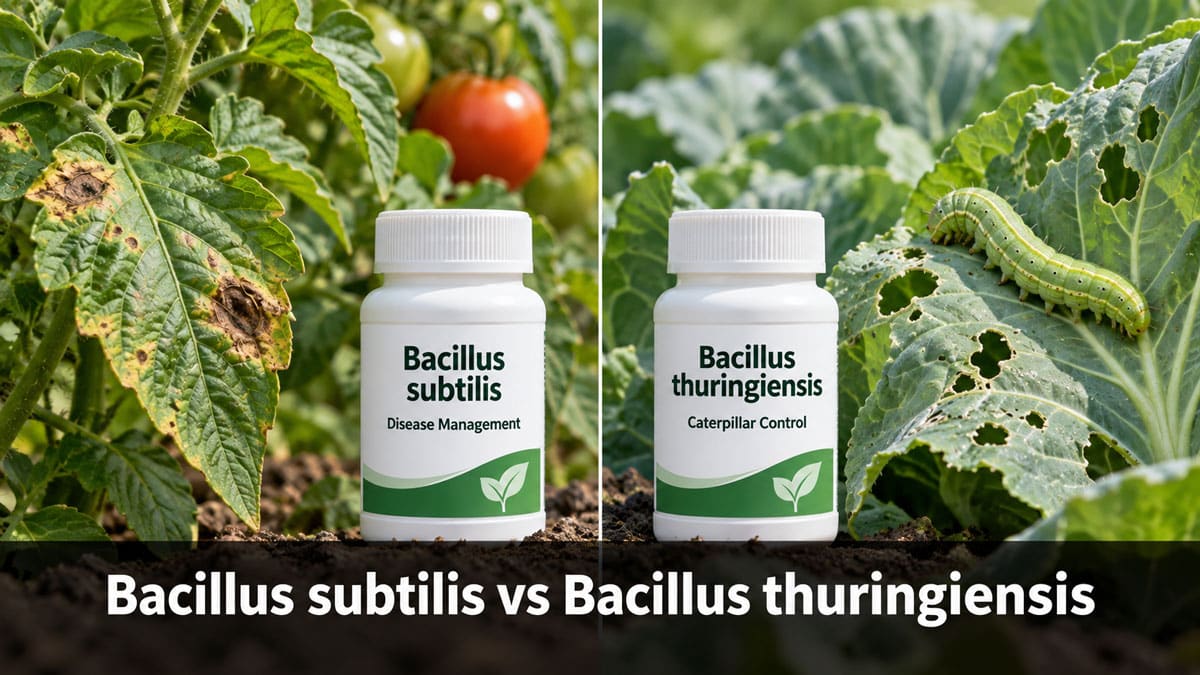
What is the difference between Bacillus subtilis and Bacillus thuringiensis?
What is the difference between Bacillus subtilis and Bacillus thuringiensis?
Bacillus subtilis and Bacillus thuringiensis are different bacteria, and their primary roles in agricultural plant protection products also differ. Bacillus subtilis products with appropriate registered uses are commonly used for crop disease management; Bacillus thuringiensis, abbreviated as Bt, is commonly used for the control of specific pests.
When choosing between the two, first determine whether the customer needs to address a disease or a pest, then verify the specific strain, target, and product information.
For importers, distributors, and brand owners, these two types of products can serve different roles within a product line. The fact that they both belong to the genus Bacillus does not mean they are interchangeable; even under the same bacterial species name, products with different uses and performance characteristics may exist.
When sourcing, it is more helpful to verify the microbial identity along with the complete commercial specifications than to compare only the bacterial names or concentrations.
What are the key differences between these two Bacillus species?
| Comparison Criteria | Bacillus subtilis | Bacillus thuringiensis |
|---|---|---|
| Chinese Name | Bacillus subtilis | Bacillus thuringiensis |
| Common Abbreviations | Procurement documents should retain the full name | Bt |
| Common Applications in Agricultural Plant Protection | Microbial fungicides, disease management products | Microbial insecticides |
| Primary product selection criteria | Target crops, specific diseases, and pathogens | Target crops, specific insect species, and life stages |
| Mechanism of action | Different strains may suppress diseases through competition, antimicrobial metabolites, etc. | Insecticidal proteins that act on susceptible pests typically require ingestion by larvae |
| Key Product Identification Elements | Species, strain number, and product composition | Subspecies, strain number, and applicable activity data |
| Quality Verification Criteria | Applicable live菌数 or other activity indicators, formulation performance, and storage stability | Applicable biological potency, other quality indicators, formulation performance, and storage stability |
| Product Line Role | Meets specific disease management needs | Meets specific pest management needs |
UF/IFAS agricultural guidelines list Bacillus subtilis strain products for fungicidal or bactericidal uses; Cornell, on the other hand, describes Bt as a microbial insecticide and explains that different types target different insect groups.
Therefore, if a Bacillus subtilis product is registered for disease control, it can be classified as a fungicide; Bt products intended for pest control can be classified as insecticides. Both may also be labeled as “microbial pesticides” to facilitate customer searches.
For microbial inputs marketed for plant growth promotion or other functions, classification should be based on actual use and local requirements; they cannot be deemed to be the same plant protection product solely based on the name “Bacillus subtilis.”
How is Bacillus subtilis used in crop disease management?
This must be determined based on specific strains and products.
Some Bacillus subtilis strains can suppress diseases by competing for nutrients and growth space or by producing antimicrobial metabolites. The specific mechanisms of action and efficacy may vary among different strains; therefore, information from one product cannot be directly applied to another.
FRAC 2026 lists several specific Bacillus strains under the category of microorganisms with multiple modes of action and explicitly states that the listed mechanisms do not necessarily apply to all biological groups.
When a customer states, “We need a biological fungicide,” we recommend clarifying the following:
- On which crop is the issue occurring?
- What disease or pathogen needs to be controlled?
- Is the product intended for foliar application, seed treatment, or the rhizosphere?
- Is this for preventive management, early intervention, or has a visible disease already appeared?
- What are the local efficacy reports and approved uses?
Even if yellowing, wilting, or root abnormalities are observed, the cause must still be determined first. Pathogen infection, nutritional issues, and environmental stress can present similar symptoms; product selection should be based on a clear diagnosis.
When evaluating Bacillus subtilis products, focus on their timing and role within a specific disease management strategy. Whether a product is suitable for post-symptom management requires supporting data; it is not appropriate to make blanket claims that “all products are only for prevention” or “all can treat” diseases.
Why is it important to consider subspecies and strains when selecting Bt?
“Bt” is a convenient shorthand for communication, but for procurement purposes, this information is incomplete.Different types of Bt may produce different insecticidal proteins and target different pests. Products designed for agricultural caterpillar control cannot directly replace those intended for mosquito larvae control.
| Common Types | Primary Target Categories | What else to verify during procurement |
|---|---|---|
| Bt subsp. kurstaki, Btk | Specific Lepidoptera larvae | Specific pest species, strains, potency, and approved uses |
| Bt subsp. aizawai, Bta | Specific Lepidoptera larvae | Efficacy against target pest species and local application conditions |
| Bt subsp. israelensis, Bti | Specific Diptera larvae, such as mosquito larvae | Target pests, application sites, and product instructions |
| Bt subsp. tenebrionis | Specific beetle larvae | Specific targets and approved uses |
The NPIC data clearly distinguishes the primary control targets for these types. The uses listed in the table help you understand the classification; however, specific purchasing decisions should still be based on product labels and efficacy data.
Both Btk and Bta target Lepidoptera larvae, but this does not mean they perform identically against every pest. For example, when a customer asks about the cabbage looper, diamondback moth, or a specific noctuid moth, you should verify separately whether the product covers the specific target species, rather than lumping them together with a general statement like “it kills caterpillars.”
How do application timing and coverage affect actual performance?
The application conditions to be considered differ between the two product categories.
For Bacillus subtilis disease management products, the focus is on ensuring the product works at the appropriate time, on the appropriate parts of the plant, and under the specified conditions. For foliar, seed, and rhizosphere applications, follow the instructions for the corresponding product; do not apply one product’s instructions to another simply because they share the same bacterial strain.
For common Bt larval control products, ingestion and exposure are critical factors. Cornell’s research emphasizes that target pests must ingest the Bt, making spray coverage particularly important.
If larvae have already entered fruits, stalks, or other concealed areas, it is necessary to reassess whether the product can reach the feeding sites. The larval stage, pest pressure, and spray window should also be factored into the evaluation.
When observing efficacy, consider the following factors:
- Changes in live pest populations and feeding activity;
- Whether new damage has decreased;
- Pest life stage and coverage conditions at the time of application;
- The observation periods specified in the label or trial data.
Existing insect holes, galleries, or leaf damage will not recover immediately. Judging a product’s ineffectiveness based solely on old damage can easily lead to errors.
The product’s mode of action should be translated into application instructions that customers can follow. It is not appropriate to make uniform claims regarding the speed of effectiveness or residual duration for all microbial products.
Why do strain, bacterial count, and potency need to be verified separately?
The specifications of microbial products cannot be summarized using a single percentage.
Relevant FAO documentation links the composition of microbial products to CFU or other effective biological potency indicators. Different indicators address different questions.
| Indicator | What it primarily indicates | Points to Note When Comparing |
|---|---|---|
| Species and Strain Numbers | Identity of microorganisms in the product | The same species name does not necessarily mean the same strain |
| Percentage, g/kg, or g/L | Composition or content labeled according to specified criteria | Clearly specify the subject, units, and measurement method |
| CFU/g, CFU/mL | Number of colonies formed under specified culture conditions | Must correspond to the specific testing method and conditions |
| Biological potency units such as IU, ITU, etc. | Activity evaluated under specific bioassay and reference systems | Values from different assay systems cannot be directly compared |
| Field efficacy data | Performance under specific crops, targets, and application conditions | Verify whether test conditions are relevant to the target market |
CFU stands for colony-forming units. It relates to the number of cultivable bacteria under specific testing conditions and cannot be directly converted to field efficacy.For Bt, the number of viable bacteria cannot substitute for an evaluation of insecticidal activity. Comparisons of biological potency also require knowledge of the reference material, test subject, method, and units; figures from different systems cannot simply be compared side by side.
For disease management products, a higher bacterial count does not automatically indicate better efficacy. It must be evaluated in conjunction with strain characteristics, product composition, intended use, and efficacy data.
Importers can first confirm with the supplier:
“What does this specification indicate? What testing method was used? To which batch do the results correspond? What criteria must still be met after storage?”
Only after this information is clarified can a quotation be accurately compared.
Microbial names may also undergo historical taxonomic changes. When document names do not match, verify the strain number, identification data, and registration information to confirm whether they refer to the same product identity.
How should storage, packaging, and quality upon arrival be evaluated?
Microbial products may consist of spores, other microbial forms, and related active components; the specific composition should be confirmed based on the product. Storage requirements cannot be inferred solely on the basis that “they are all Bacillus species.”
The FAO’s principles for microbial evaluation include information on viability or potency after storage. During procurement, both factory test results and documentation supporting storage and use should be verified.
| Items to Verify | Recommended Specifications |
|---|---|
| Product Identity | Species, subspecies, or strain number and applicable identification data |
| Activity Specifications | Applicable live bacteria count, potency, or other indicators |
| Contamination Control | Test items, methods, and limits for foreign microorganisms and related contaminants |
| Formulation Properties | Select applicable items based on the actual formulation (e.g., SC, WP, WG) |
| Storage Stability | Conditions, duration, and post-storage activity and performance |
| Packaging | Material, sealing, moisture protection, and applicable protective requirements |
| Shelf life | Labeling basis, storage conditions, and remaining shelf life upon arrival |
| Batch traceability | Batch number, production information, test reports, and supply records |
These items must be determined based on the specific product and applicable requirements; uniform limits are not set for all microbial formulations.
Transportation, port warehousing, and channel inventory should be considered collectively. Even if a product meets specifications upon leaving the factory, the impact must be assessed if actual distribution conditions exceed the product’s permissible range.
Temperature and storage requirements may vary by product. Transportation and storage should be arranged according to product specifications; it should not be assumed that all microbial pesticides require a cold chain, nor that they can be stored indefinitely at room temperature.
For seasonal stockpiling, projected sales and remaining shelf life must be calculated together. Purchase volumes should support reasonable inventory turnover.
Can the product be mixed with other pesticides? How should resistance management be addressed?
Mixing must be evaluated on a product-by-product basis.
The fact that two products are both microbial pesticides does not automatically mean they can be mixed. When used in combination with fungicides, bactericides, fertilizers, or adjuvants, labels, compatibility data, and relevant restrictions must also be verified.
Mixing requirements vary among the different Bacillus products listed by UF/IFAS. Therefore, it is not appropriate to make a blanket statement that “all biological products can be mixed,” nor should it be generally assumed that any fungicide will inactivate all Bacillus formulations.
The absence of visible stratification or flocculation merely indicates that no specific physical abnormalities were observed; it does not, on its own, prove that microbial activity, efficacy, and crop safety have all been preserved.
Resistance management should be focused on a specific target pathogen or pest.
Bt and its insecticidal proteins are classified in IRAC Group 11A. Rotation schedules between different Bt products should be based on specific pest and product recommendations; conclusions should not be drawn solely based on subspecies names.
For Bacillus subtilis disease management products, verify the applicable FRAC classification and program requirements. Products used for disease management and those used for pest control cannot be rotated as substitutes for the same target.
Do distributors need to stock both types of products simultaneously?
It depends on whether your distribution channels have distinct demand for both.
If customers have both disease management needs and corresponding larval control needs, then each product category may serve a distinct role. The decision to stock both should be based on registration status, efficacy evidence, channel capacity, and inventory turnover.
| Market Demand | Product Line Evaluation Directions |
|---|---|
| Clear demand for crop disease management | Evaluate products containing the corresponding Bacillus subtilis strain |
| Clear demand for Lepidoptera larvae control | Evaluate Bt subspecies and products suitable for the target insect species |
| Concurrent demand for both disease and pest control | Determine the intended use, packaging, purchase volume, and training content separately |
| Only wish to add the “biopesticide” category | First confirm the target organisms and customer needs, then determine the specifications |
Labels and sales materials should clearly distinguish between disease and pest control uses to facilitate downstream promotion and application.
A microbial source does not automatically mean the product meets organic production requirements. If customers are targeting organic channels, the eligibility of specific products and local requirements should be verified separately.
When comparing purchases, we recommend first standardizing the strain, activity specifications, formulation, and packaging, and then calculating usage costs based on the application rates listed on the corresponding labels. The requirements for Bacillus subtilis and Bt services typically differ; it is not appropriate to directly compare which is “cheaper per hectare” to determine whether one can replace the other.
Frequently Asked Questions
Are Bacillus subtilis and Bacillus thuringiensis the same product?
No. They are different bacteria with distinct commercial applications in agricultural pest control. When purchasing, it is also necessary to verify the specific strains and product specifications.
Should Bacillus subtilis products be classified as fungicides or insecticides?
Products registered for disease control are typically classified as fungicides. Agricultural inputs intended for other uses should be classified according to their actual product information.
Can all Bt products control cabbage loopers and diamondback moths?
This cannot be generalized. Bt has different subspecies and strains; it is necessary to verify the target pest species, approved uses, and efficacy basis for each specific product.
Are Btk and Bti interchangeable?
They are not directly interchangeable. Btk is commonly used for the control of specific Lepidoptera larvae, while Bti is commonly used for the management of specific Diptera larvae, such as mosquito larvae; their target pests differ.
Does a higher live bacterial count necessarily mean better efficacy?
Not necessarily. The strain, active ingredients, testing criteria, formulation, and application conditions all influence the evaluation results. For Bt products in particular, the live bacterial count alone cannot be used as a substitute for assessing biological potency or efficacy.
Can Bacillus subtilis and Bt be mixed together?
This must be confirmed based on the specific product. Review the labels of both products and relevant compatibility data; do not assume they are compatible simply because they are both Bacillus species.
Does a biological origin mean the product does not require registration or automatically qualifies for organic certification?
No. Product registration and eligibility for organic production must be verified separately; conclusions cannot be drawn directly based on the source.
Confirm Microbial Product Specifications for Your Market
If you are evaluating Bacillus subtilis and Bt for import, distribution, or private-label projects, please provide the following information to Mafa Agro:
- Destination country, company type, and local registration status;
- Target crops, specific diseases, or pest species;
- Planned application sites, timing, and existing efficacy feedback;
- Required species, subspecies, or strain specifications;
- Live bacterial count, biological potency, and related testing requirements;
- Formulation, packaging specifications, label language, and estimated purchase volume;
- Information on transportation, storage, and required technical documentation.
Based on the specific product and project conditions, we will verify available specifications, the documentation we can provide, and packaging options to help you clarify the details that need to be confirmed for sample evaluation and bulk procurement.
Tell Us What You Need
Looking for pesticide products from China? Send us the active ingredient, formulation, quantity, packaging requirement or target crop. Our team will help you evaluate suitable supply options.