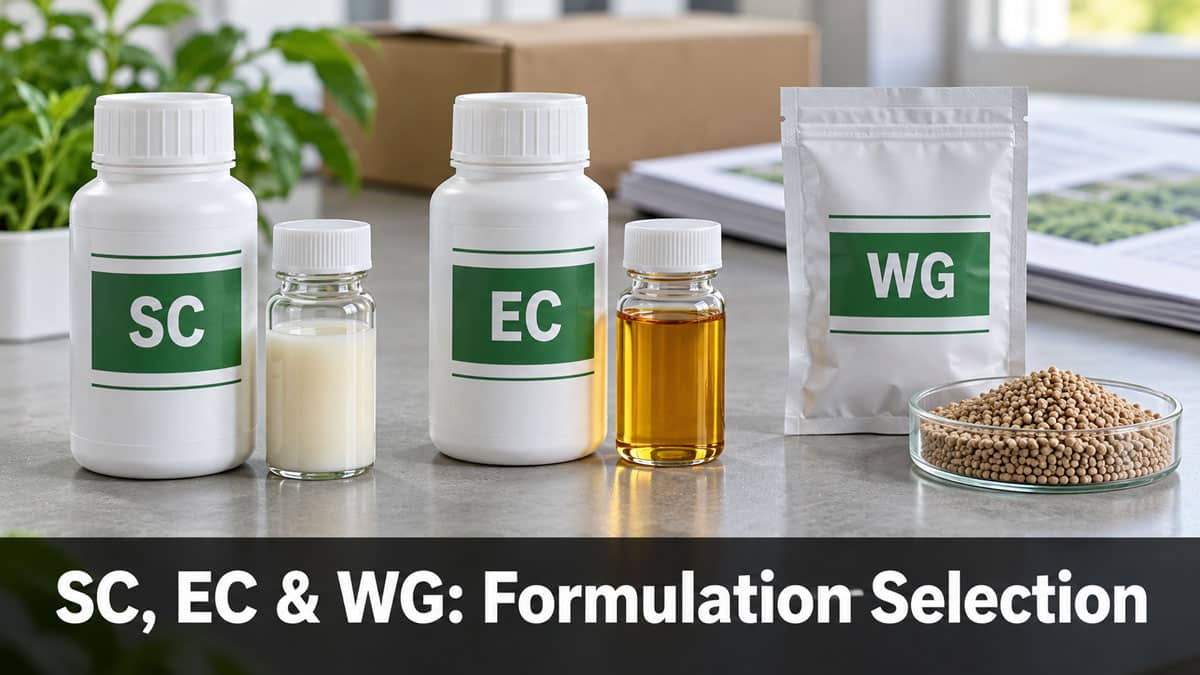
SC, EC, and WG: What Should Importers Consider When Selecting Pesticide Formulations?
SC, EC, and WG: What Should Importers Consider When Selecting Pesticide Formulations?
When selecting between SC, EC, or WG, importers should first verify the registration status and available specifications in the destination country, then compare local application conditions, formulation quality, storage, transportation, and packaging, as well as actual procurement costs. SC stands for suspension concentrate, EC for emulsifiable concentrate, and WG for water-dispersible granules. These three formulations have distinct physical properties and different key acceptance criteria; determining which is best suited for your market requires a product-specific analysis.
For importers, distributors, and brand owners, the choice of formulation impacts subsequent sample approval, packaging, inventory management, and channel training. A product must not only meet the agreed-upon concentration but also be capable of being stored, mixed, and applied under specified conditions. Clearly defining these requirements before comparing quotes is essential to assessing the actual value of different supply options.
What are the key differences between SC, EC, and WG?
To understand these three formulations, first consider the state of the active ingredient within the formulation and the system it forms when water is added.
| Comparison Items | SC | EC | WG |
|---|---|---|---|
| Chinese Name | Suspension Concentrate | Emulsifiable Concentrate | Water-Dispersible Granules |
| Original Product Form | Solid active ingredient particles suspended in an aqueous continuous phase | Homogeneous liquid formulation, with the active ingredient dissolved in the formulation system | Granular formulation |
| Main Process After Adding Water | Dilution and dispersion to form a suspension system | Emulsification to form an emulsion | Wetting, disintegration, and dispersion of granules to form a dispersed suspension system |
| Key Quality Verification Points | Suspension, dispersion, pouring, and post-storage performance | Emulsion stability, re-emulsification, and appropriate storage performance | Wetting, dispersion, suspension, wet sieving, and granule storage performance |
| Packaging considerations | Pouring, residuals in the bottle, sealing, and packaging compatibility | Compatibility of the formulation with the bottle, cap, gasket, and seal | Moisture protection, sealing, granule integrity, and use after opening |
The APVMA’s formulation classifications define SC as an aqueous suspension system, EC as a homogeneous liquid formulation that forms an emulsion upon dilution, and WG as a granular formulation used after disintegration and dispersion in water.
The “dispersion” in WG must be distinguished from the “dissolution” in SG. In commercial materials, “WDG” is commonly used to describe water-dispersible granules; however, contracts, labels, and registration documents should consistently use the validated formulation names and codes.
These abbreviations describe the physical form of the formulation and do not, on their own, demonstrate efficacy, residual efficacy, or crop safety. Such performance characteristics still require support from corresponding product data and application conditions.
For the same active ingredient, can three different dosage forms be chosen freely?
First, confirm which mature, commercially available formulations exist.
The solubility, chemical stability, target concentration, and formulation composition of the active ingredient will influence formulation design. Just because an ingredient can be formulated as an EC does not mean it can be stably formulated as an SC or WG at the same concentration.
When a supplier proposes a new dosage form, you can ask:
- Is this a specification already in production, or is it still under development?
- Which formulation version and production batch does the sample correspond to?
- Which performance and storage stability evaluations have been completed?
- What documentation is available for this specification?
- What quality standards will be used for bulk supply?
The availability of samples is the starting point for evaluation. For bulk procurement, you must also confirm the complete specifications, quality performance, and supply terms.
If feasible solutions exist for several formulation types, proceed to compare them for market suitability. There is no need to procure new specifications for which there is no clear demand simply to add another formulation name.
Why verify registration first, then compare prices?
The formulation may be part of the product’s registration identity.
Take Australia as an example: the APVMA lists dosage form codes and descriptions as mandatory product characteristics and has established evaluation pathways for formulation changes. Other target countries must be assessed individually based on local requirements.
Suppose you already have a registered EC product, and a supplier offers a quote for an SC formulation with the same active ingredients and concentrations. This option can proceed to technical evaluation, but the product cannot be considered a direct substitute for the originally registered product solely based on matching active ingredients and concentrations.
The following must be verified:
| Project | Items to Clarify Before Procurement |
|---|---|
| Product Identity | Active Ingredients, Concentrations, Units, Formulation, and Complete Specifications |
| Registration Match | Whether the product to be procured is consistent with existing or planned registrations |
| Formulation and Source | Whether the formulation, production source, and related documentation meet project requirements |
| Scope of Use | Crops, targets, application rates, and other label conditions |
| Change Requirements | Does changing the formulation, composition, or source require supplementary data or evaluation? |
During procurement discussions, we recommend addressing the registration status alongside the target specifications. This ensures that quotations, samples, and documentation can all be processed under the same product project.
What quality parameters need to be checked for different formulations?
The active ingredient content alone is insufficient to fully assess the quality of a formulation.
The FAO’s pesticide specification framework typically covers appearance, active ingredient content, relevant impurities, physicochemical properties, and storage stability. For SC, EC, and WG formulations, applicable items should be selected based on their respective systems.
| Formulation | Key Items to Verify | Significance for Actual Use |
|---|---|---|
| SC | Suspension rate, dispersibility, wet sieving, pourability, storage stability; particle size and viscosity when necessary | Verify that the product can be restored to a uniform state, poured normally, and form a suspension system suitable for spraying |
| EC | Emulsion stability, re-emulsification, performance at applicable low and high storage temperatures, and relevant physicochemical parameters | Verify that both the original product and the diluted emulsion meet specifications |
| WG | Wettability, dispersibility, suspension rate, wet sieving, dust generation, and applicable flow and abrasion resistance parameters | Verify whether the granules disperse normally and whether they retain suitable performance after storage and handling |
The FAO’s specific pesticide specification documents list these types of physicochemical test items. Specific test items, methods, and limit values should be determined based on the product, applicable specifications, and mutual agreement between the parties. These items serve as verification guidelines, not a fixed set of acceptance criteria applicable to all products.
For SC formulations, attention should be paid to whether the product can regain uniformity in the prescribed manner after settling. The occurrence of minor settling that forms a hard deposit difficult to redisperse cannot be generalized with the single phrase “precipitation present.” The final determination must still be based on applicable specifications and test results.
For EC formulations, the fact that the liquid in the original bottle is clear is not sufficient proof that the emulsification performance after dilution is acceptable. Evaluation should be conducted according to the agreed-upon water quality, concentration, temperature, and observation conditions.
For WG, the fact that particles disperse quickly upon contact with water does not necessarily mean that all performance criteria are met. Wetting, dispersion, and suspension tests are used to address different issues, and tests such as wet sieving can also be used to check for coarse residues.
Test conditions should be specified in the evaluation report. Results lacking details on methodology, water quality, dilution concentration, or observation time are generally difficult to use for accurate comparisons between suppliers.
How do local water conditions and application equipment influence product selection?
Standardized testing helps you verify product quality, while an assessment of local conditions helps you determine suitability for use.
Importers can collect data on the pH, hardness, and other relevant characteristics of the actual water used and discuss with suppliers whether additional testing is necessary. When making comparisons, it is best to use clearly defined dilution concentrations, agitation methods, temperatures, and observation procedures.
Equipment conditions must also be considered:
- Does the sprayer have the agitation capacity required by the label?;
- Are the filtration system and spray nozzles suitable for the product’s application requirements?;
- Can end-users correctly measure, dispense, and complete dispersion?;
- Do actual formulation and application procedures comply with label instructions?
For SC and WG suspension formulations, attention should be paid to the applicable agitation and operational requirements. For EC formulations, emulsification performance and specific usage instructions must be verified. It cannot be assumed that liquid products never require agitation, nor that granular products will inevitably clog spray nozzles.
A simple cup test can reveal some visible physical abnormalities, but it cannot replace agreed-upon standardized testing, nor can it alone prove the efficacy and crop safety of the product after tank mixing.
The more specific the local water samples, equipment information, and product instructions are, the easier it will be to implement subsequent channel training.
What factors should be considered together regarding transportation, warehousing, and packaging?
International orders may go through transportation, port warehousing, importer inventory, and downstream distribution from production to final use. The condition of a sample immediately after production covers only part of the supply chain.
| Supply Chain Conditions | Recommended Items for Verification |
|---|---|
| High temperatures, low temperatures, or temperature fluctuations | Permissible storage conditions for the product and corresponding stability data |
| Long-distance transportation | Packaging seal, integrity, and transportation conditions |
| Seasonal Stockpiling | Remaining Shelf Life Upon Arrival vs. Expected Sales Cycle |
| Small-Volume Liquid Packaging | Spillage, Residue, Bottle Neck Design, and Seal Performance |
| WG Bagged Products | Moisture barrier performance, sealing, particle integrity, and storage instructions after opening |
SC should focus on product-specific behaviors such as settling, thickening, hard deposits, and redispersion. EC should focus on potential crystallization, phase changes, and emulsification performance after storage. WG should focus on moisture absorption, caking, and changes in particle properties.
Penn State’s storage guidelines indicate that dry formulations may cake when exposed to moisture or high humidity. Therefore, moisture-proof packaging and warehouse management for WG products must also be included in the procurement evaluation.
Packaging should be validated in conjunction with the formulation. For EC products, the formulation system may influence the selection of bottles, caps, gaskets, or sealing materials; for SC products, pour performance is related to the design of the bottle opening and body; and for WG products, packaging moisture barrier properties and post-use storage conditions must be considered.
Storage reports should specify both test conditions and test results. An accelerated storage test should not be directly converted into a fixed shelf life, nor should it be inferred that the product can be stored long-term in any environment.
Transportation classification and related arrangements should be verified based on specific product data and applicable requirements; they should not be determined solely by the SC, EC, or WG designation.
How should cost per hectare and cost, insurance, and freight (CIF) be compared?
Comparing quotes based on price per liter or per kilogram is the first step in procurement calculations. To assess commercial value, it is also necessary to standardize the comparison criteria and measurement units.
For the same crop, target, and control objective, you can first calculate:
Product cost per hectare per application = CIF unit price (per liter or per kilogram) × the product application rate per hectare permitted by the local label.
Then, factor in the adjuvants, necessary combinations, and other inputs required by the label for the actual application plan.
When comparing liquid and granular products, you must also verify the active ingredient concentration and the unit of measurement used in the quote:
- Whether the percentage is w/w or w/v;
- Whether the concentration is expressed in g/L or g/kg;
- Is the liquid quoted per liter or per kilogram?
- If conversion is needed, are clear data such as density available?
Do not assume that 1 L of product equals 1 kg of product.
Suppose you are evaluating a WG (water-based) solution and wish to reduce transportation costs. You will need to further calculate the gross weight after packaging, volume, loading capacity, application rate per unit area, and related transportation costs. The term “WG” alone does not prove that the cost, delivered to destination, will necessarily be lower than that of a liquid solution.
| Cost Dimensions | Comparison Criteria |
|---|---|
| Product Usage Costs | Corresponding label application rates, additives, and necessary combinations |
| Logistics Costs | Gross weight, volume, loading capacity, packaging, and shipping conditions |
| Inventory costs | Minimum order quantity, seasonal demand, replenishment cycle, and inventory turnover |
| Channel service costs | Dosing instructions, usage training, and troubleshooting |
| Project Costs | Sample evaluation, documentation preparation, and applicable registration procedures |
A product with a higher unit price may still offer reasonable procurement value if it aligns with existing registrations, packaging channels, and usage habits. For lower-priced options, it is essential to first confirm the technical scope and project conditions before determining whether a switch is worthwhile.
How to narrow down the range of dosage forms based on different procurement needs?
There is no need to ask suppliers to provide separate quotes for three dosage forms right from the start. First, clarify the most critical issues the project needs to address; this makes it easier to obtain targeted proposals.
| Your Procurement Situation | Priority Actions |
|---|---|
| Existing stable sales and valid registration | Verify original specifications, batch consistency, packaging, and restocking conditions |
| Existing liquid products have spillage or packaging issues | Examine formulation and packaging causes before evaluating improvements or alternatives |
| Distribution channels wish to add granular products | Confirm feasibility of WG specifications, registration, dispersion performance, and moisture-proof packaging |
| Significant long-distance transportation and seasonal inventory fluctuations | Review storage data, packaging, and remaining shelf life at the time of delivery in advance |
| Significant variations in downstream equipment and dispensing capabilities | Assess product and training needs based on equipment conditions and operational requirements |
| First-time development of a private label | Validate dosage form, specifications, documentation, packaging, and labeling as a single project |
Addressing issues with a product does not necessarily require an immediate change in dosage form. First, identify the root cause to determine whether adjusting the packaging, refining the operating instructions, or developing a different strength is more suitable for current business needs.
Once a sample is approved, how do you transition to bulk procurement?
Sample evaluation requires clear acceptance criteria.
Before submitting samples, we recommend first agreeing on the ingredients, content, dosage form, applicable test items, methods, limit values, and packaging conditions, and specifying the formulation version and batch that the sample represents.
Batch orders should continue to be verified against the same set of specifications:
| Phase | Recommended Records to Retain |
|---|---|
| Requirement Confirmation | Destination Country, Product Identity, Intended Use, and Commercial Specifications |
| Sample Evaluation | Sample Lot Number, Formulation or Specification Version, Methods, and Results |
| Packaging Approval | Packaging materials, specifications, sealing, labeling, and compatibility requirements |
| Batch Acceptance | Actual batch COA, applicable test results, and packaging inspection records |
| Subsequent Changes | Description and evaluation of key changes to formulation, source, packaging, etc. |
Test results must correspond to the actual sample or commercial batch; reports from previous samples cannot be used as test results for new batches.
COAs are used to verify batch specifications, SDS/MSDS are used to understand hazards and related management information, and TDS are used to describe product technical information. Efficacy, registration, and transportation documentation should be verified separately according to their respective purposes.
After a sample is approved, the supplier must still organize shipments in accordance with the agreed-upon specifications. When changes to key conditions are involved, communicating in advance about their impact on quality, documentation, registration, and performance will help reduce deviations in repeat orders.
Frequently Asked Questions
Is SC always better than EC?
There is no universal conclusion. It is necessary to compare the specific product’s registration status, efficacy basis, quality, conditions of use, storage and transportation packaging, and cost. The designations “SC” or “EC” do not directly indicate a product’s grade.
Is WG a granule that is completely soluble in water?
WG stands for water-dispersible granule, where the granules disintegrate and disperse in water. SG stands for water-soluble granule; the two should be verified separately and must not be confused.
Can a formulation be directly substituted with another of the same active ingredient and concentration?
Substitution cannot be assumed without verification. It is necessary to confirm formulation feasibility, registration in the destination country, labeling, quality specifications, and relevant documentation requirements.
Does sedimentation in an SC formulation necessarily indicate a failure to meet standards?
Conclusions cannot be drawn based solely on appearance. The nature of the sedimentation, the behavior after redispersion according to specified methods, and whether the applicable parameters meet the agreed-upon specifications must be verified.
If an EC formulation appears clear in the original bottle, does that mean it is of good quality?
Clarity is only one aspect of appearance. It is also necessary to verify ingredient concentrations, the performance of the emulsion after dilution, storage stability, and other applicable parameters.
Does WG always result in lower shipping costs?
Not necessarily. Calculations must be based on specific concentrations, gross packaging weight, volume, loading capacity, shipping conditions, and labeled usage amounts.
If the sample performs well, is testing of the production batch still required?
Commercial batches must be verified against the agreed-upon acceptance criteria. Sample confirmation helps establish standards, but actual batches must still meet the corresponding quality and traceability requirements.
Confirm dosage forms and packaging specifications for your market
If you are comparing SC, EC, and WG formulations for import, distribution, or private-label projects, please provide the following information to Mafa Agro:
- Destination country, company type, and current or planned registration status;
- Target crops, targets, and primary application scenarios;
- Required active ingredients, concentrations, units of measurement, and formulations;
- Local water availability, equipment, and existing application feedback;
- Estimated purchase volume, peak demand season, and storage arrangements;
- Packaging specifications, label language, and branding requirements;
- Requirements for sample testing, acceptance, and technical documentation.
Based on the specific product and project conditions, we will verify available specifications, documentation, and packaging options to help you define the scope of sample evaluation and proceed with procurement according to the confirmed commercial specifications.
Tell Us What You Need
Looking for pesticide products from China? Send us the active ingredient, formulation, quantity, packaging requirement or target crop. Our team will help you evaluate suitable supply options.